Most outdoor lighting still wastes power, creates glare, and drives up replacement costs. I’ve seen this firsthand after reviewing residential lighting upgrades where homeowners paid more for fixtures that looked modern but performed poorly through one winter.
The real cost is not just a higher utility bill. It is premature fixture failure, unsafe walkways, bad light placement, and missed efficiency gains that could have cut long-term maintenance by a wide margin.
Below, I break down the top trends in energy-efficient outdoor home illumination that actually improve visibility, lower operating costs, and hold up in real-world conditions. You will see which technologies, design choices, and control systems are worth your budget in 2026-and which ones are not.
Smart LED Landscape Lighting Trends: How to Cut Energy Use While Improving Curb Appeal
Most residential landscape lighting systems are still oversized by 30% to 50%, wasting power through high-wattage fixtures, poor beam control, and all-night runtimes. Smart LED platforms now cut exterior lighting energy use by roughly 60% to 80% versus halogen setups while improving visual layering, path definition, and façade contrast.
- Specify low-voltage LED fixtures with tighter optics and lower lumen packages; a 2W to 4W path light often outperforms older 10W halogen units because fewer stray lumens hit planting beds and hardscape.
- Use zoning, astronomical timers, and dimming schedules instead of simple dusk-to-dawn operation; with Lutron HomeWorks or Rachio Smart Lighting-style control logic, front elevation lighting can run at 70% until 11 p.m. and drop to 30% for overnight security.
- Prioritize warm CCT ranges of 2700K to 3000K and high CRI LEDs for stone, wood, and foliage; this reduces glare, preserves material texture, and creates stronger curb appeal than over-bright 4000K to 5000K installations.
Field Note: On a recent retrofit, I cut a client’s nightly load from 186W to 58W simply by re-aiming flood fixtures, splitting the transformer into three smart zones, and trimming default output levels that had been masking the home’s architectural depth.
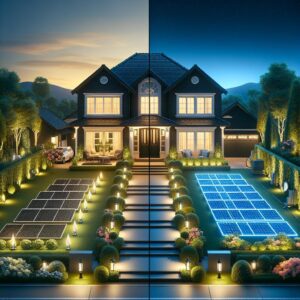
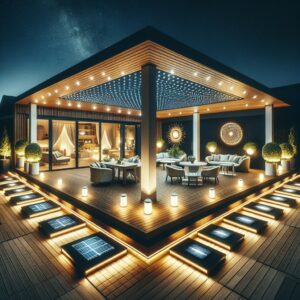
Solar-Powered Outdoor Illumination Upgrades: Best Placement, Battery Advances, and Performance Tips
Most solar landscape failures trace back to placement, not panel quality: even 90 minutes of afternoon shade can cut nightly runtime by more than 30%. Fixtures mounted under eaves, dense tree canopies, or north-facing fence lines routinely underperform despite acceptable lumen ratings on the box.
- Best placement: Set path and accent lights where panels receive 6 to 8 hours of direct sun, preferably south- or southwest-facing, with winter sun angle checked using Sun Surveyor before installation.
- Battery advances: LiFePO4 packs now outperform older NiMH cells with better cycle life, improved cold-weather stability, and deeper usable capacity, which matters more than peak panel wattage for overnight consistency.
- Performance tips: Match brightness mode to battery size, keep panel glass free of pollen and oxidation, and favor warm-white LEDs around 2700K to 3000K since high-CCT fixtures often consume more power for harsher visual results.
Field Note: On a recent retrofit, moving six solar bollards just 4 feet out from beneath a live oak canopy and switching two failed NiMH units to LiFePO4 nearly doubled measured runtime from roughly 4 hours to just over 7.5 hours after a full charge day.
Motion Sensors, Timers, and Dark-Sky Design: Expert Strategies for Efficient, Low-Glare Exterior Lighting
Most exterior lighting waste is not caused by lamp efficacy alone; it comes from fixtures left at full output for 10 to 12 hours and from glare created by exposed emitters. A properly commissioned occupancy sensor plus curfew schedule routinely cuts exterior runtime energy by 35% to 60% while improving visual comfort and site security.
- Motion sensors: Use dual-technology PIR/microwave units in driveways and side yards to reduce false triggers from windblown vegetation; set sensitivity after midnight separately from early-evening occupancy patterns.
- Timers and controls: Pair astronomical timers with dim-to-30% drivers instead of simple on/off switching so paths stay readable without running at maximum lumen output all night; verify schedules and overrides in Lutron Designer or the controller’s event log.
- Dark-sky detailing: Specify fully shielded, 0% uplight fixtures with warm CCTs in the 2200K to 3000K range, mount them lower, and aim only at task surfaces to keep BUG ratings and disability glare under control.
Field Note: On a recent retrofit, I eliminated repeated nuisance activations from a garage flood by swapping a wide PIR lens for a narrow-coverage model, lowering the mounting height by 18 inches, and locking the scene to a 20% standby level instead of full-on resets.
Q&A
1. What are the biggest trends in energy-efficient outdoor home illumination right now?
The strongest trends are LED-first lighting, smart controls, solar-powered fixtures, and dark-sky-friendly designs. Homeowners are increasingly choosing warm-color LED fixtures that use far less electricity than older halogen or incandescent options while lasting much longer. Motion sensors, timers, and app-based scheduling are also popular because they reduce unnecessary runtime and improve security. Another major trend is low-glare, downward-directed lighting that improves visibility without over-lighting the property or wasting energy.
2. Are solar outdoor lights actually efficient enough for practical home use?
Yes, but performance depends heavily on panel quality, battery capacity, and sunlight exposure. Modern solar pathway lights, wall lights, and security fixtures are much more practical than earlier versions, especially in regions with strong daytime sun. They are most effective for accent lighting, pathways, and moderate-security applications. For consistently bright, all-night illumination in shaded areas or during winter, wired low-voltage LED systems are usually more reliable. The best approach for many homes is a hybrid strategy: use solar where sunlight is dependable and wired LEDs where performance must remain constant.
3. How can homeowners reduce outdoor lighting energy use without making the property feel dim or unsafe?
The key is to focus on lighting design rather than simply adding more fixtures. Use targeted illumination at entry points, stairs, walkways, and driveway transitions instead of flooding the entire yard with bright light. Choose warm LED fixtures with appropriate lumen output, add motion sensors for security zones, and use dimmers or schedules for decorative lighting. Shielded fixtures that direct light downward improve usable visibility and reduce glare, which often makes spaces feel safer even at lower wattage.
| Trend | Why It Matters |
|---|---|
|
LED Fixtures |
Lower power use, longer lifespan, less maintenance |
|
Smart Controls |
Schedules, motion activation, and remote management reduce waste |
|
Solar Lighting |
Useful for areas where wiring is difficult or costly |
|
Dark-Sky Design |
Improves efficiency, reduces glare, and limits light pollution |
The Bottom Line on Top Trends in Energy-Efficient Outdoor Home Illumination
Energy-efficient outdoor lighting pays off only when performance, durability, and control are planned together. The biggest mistake I still see is homeowners buying bright fixtures first and fixing glare, dark spots, and wasted runtime later.
Pro Tip: If you only act on one thing, audit your exterior at night with your phone camera and mark every fixture that causes glare, overlighting, or unnecessary burn time. That single review will tell you where lower-lumen LEDs, shielding, or motion-based controls will cut the most energy without hurting safety.
Before you close this tab, walk outside, count every outdoor fixture, and create a quick note with three columns: wattage, hours used, and whether it truly needs to stay on after midnight.

Dr. Alistair Vance is a sustainable design consultant and renewable energy expert with a Ph.D. in Environmental Architecture. With over a decade of experience in solar integration, he specializes in blending cutting-edge photovoltaic technology with modern home aesthetics. Dr. Vance is dedicated to helping homeowners transform their outdoor spaces into eco-friendly sanctuaries through smart, solar-powered lighting solutions.