A “low-maintenance” garden usually fails because it still depends on constant watering, pruning, weeding, and replacing dead plants. I’ve seen homeowners spend hundreds each season fixing landscapes that were supposed to save time, only to inherit a yard that looks tired by midsummer and drives up upkeep instead of cutting it.
In my experience designing resilient outdoor spaces, the gardens that truly stay attractive with minimal effort are built around the right structure first: drought-smart planting, weed-blocking ground cover, durable hardscaping, and solar lighting placed with purpose.
Below, I break down the exact design approach to build a garden that needs very little attention, lowers ongoing maintenance, and still looks polished day and night with solar accents.
Zero-Maintenance Garden Design: Drought-Tolerant Planting, Weed-Suppressing Ground Covers, and Smart Layouts That Eliminate Upkeep
Most “low-maintenance” gardens fail because plant spacing is too generous and exposed soil becomes a weed nursery within one growing season. A true zero-maintenance layout relies on hydrozoning, dense massing of drought-tolerant species, and mineral mulches modeled in SketchUp or irrigation zones verified with Hunter Hydrawise.
- Use region-matched xeric plants with mature spacing that achieves 85-90% canopy closure in two years; this cuts light at the soil surface and suppresses annual weed germination.
- Replace high-maintenance turf edges with weed-suppressing ground covers such as creeping thyme, Dymondia, sedum, or trailing lantana, backed by 75-100 mm of angular gravel or decomposed granite rather than bark that breaks down and feeds weed seed.
- Lay out beds in broad, accessible zones with no narrow strips, minimize lawn-to-bed transitions, and keep hardscape flush and continuous so debris does not collect in joints or force hand weeding.
Field Note: On a south-facing courtyard retrofit, switching from bark to 10 mm crushed granite and tightening the planting matrix from 600 mm to 350 mm centers eliminated the client’s quarterly weeding cycle after the second summer.
How to Use Solar Accents in a Low-Maintenance Landscape: Path Lights, Water Features, and Focal Points That Work Without Wiring
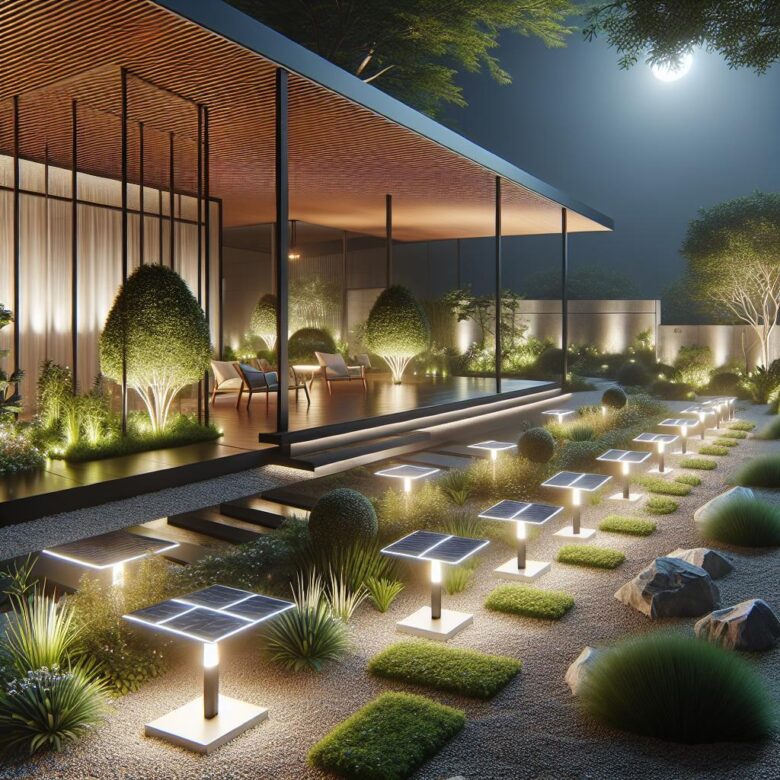
Most solar failures in low-maintenance gardens trace to placement, not product quality: even premium fixtures lose 30-50% output if panels sit in fragmented shade for part of the charging window. Use path lights only where they can charge for at least six direct-sun hours, keep beam spacing at 6-8 feet for wayfinding rather than runway brightness, and reserve higher-lumen units for steps and grade changes.
| Solar Accent | Best Low-Maintenance Use | Technical Requirement |
|---|---|---|
| Path lights | Edge primary circulation routes and entries | Warm 2700-3000K LEDs, sealed housings, stake bases set outside mower lines |
| Solar water features | Small recirculating bowls or bubbler urns | Independent panel with south exposure, removable pump screen, algae-resistant dark basin |
| Focal-point accents | Uplight specimen pots, sculpture, or architectural boulders | Single high-output fixture aimed at textured surfaces; verify spread and glare in Dialux evo |
Field Note: On a courtyard retrofit, I moved three “underperforming” solar uplights just 18 inches beyond the olive canopy dripline and doubled overnight runtime without changing a single fixture.
Expert Tips for a Self-Sustaining Garden: Mulch Systems, Hardscaping Choices, and Solar-Powered Enhancements That Cut Time and Costs
Most “low-maintenance” gardens fail because the soil surface is left exposed; that single omission can double irrigation demand and turn routine weeding into a weekly task. Build the site as a closed system: 75-100 mm of arborist wood chips over dripline-fed soil, mineral mulch only in fire-prone zones, and hardscape graded to move runoff into planting beds instead of drains.
| System | Best Practice | Time/Cost Impact |
|---|---|---|
| Mulch + irrigation | Use coarse organic mulch over pressure-compensating drip emitters; map hydrozones in Rain Bird Design Service before installation. | Reduces evaporation, suppresses germination, and cuts emitter maintenance caused by UV exposure. |
| Hardscaping | Specify permeable pavers or stabilized gravel with steel edging; avoid loose stone over weed fabric, which traps fines and roots. | Lowers runoff, prevents surface heave, and eliminates the labor of re-leveling decorative aggregate. |
| Solar enhancements | Choose integrated LED bollards or spotlights with LiFePO4 batteries and replaceable panels, not sealed budget units. | Extends service life, reduces fixture swaps, and keeps pathways lit without trenching or grid costs. |
Field Note: On a south-facing courtyard retrofit, replacing geotextile-plus-pebble mulch with 90 mm chipped hardwood and two solar bollards cut summer hand-watering visits from three per week to one while stopping the weed flush triggered by reflected heat.
Q&A
1. What plants and materials work best for a zero-maintenance garden with solar accents?
The best approach is to combine drought-tolerant, slow-growing plants with durable hardscape materials and strategically placed solar lighting. Choose plants suited to your local climate, such as native grasses, succulents, lavender, sedge, or evergreen shrubs that need little pruning or watering. Cover exposed soil with gravel, decomposed granite, or bark mulch to suppress weeds and reduce evaporation.
For solar accents, use path lights, spotlights, or decorative lanterns with high-efficiency panels and weather-resistant construction. Place them where they receive full sun for most of the day. Avoid high-maintenance lawn areas, delicate flowering annuals, and inexpensive solar fixtures that often fail quickly.
2. How do I keep a “low-maintenance” garden from still needing regular weeding, watering, and repairs?
A truly low-maintenance garden depends more on design choices than on plant selection alone. Start with a weed barrier strategy: dense ground cover, thick mulch, or gravel over properly prepared soil. Install a drip irrigation system on a timer, even for drought-tolerant gardens, because controlled watering reduces plant stress and saves time.
To minimize repairs, select solar lights made from corrosion-resistant metal or heavy-duty UV-stable plastic, and choose fixtures with replaceable batteries if possible. Keep the layout simple, with wide planting zones instead of many small beds that are harder to maintain.
- Use native or climate-adapted plants to reduce watering and disease problems.
- Mulch deeply to suppress weeds and stabilize soil moisture.
- Limit plant variety so care routines stay simple and predictable.
- Position solar lights correctly to avoid performance issues caused by shade.
3. Where should solar accents be placed so they look attractive and still perform well year-round?
Solar accents should be placed where they receive 6 to 8 hours of direct sunlight, while also supporting the garden’s visual structure at night. The most effective locations are along pathways, near focal plants, beside seating areas, and at entry points. Avoid placing fixtures under tree canopies, roof overhangs, or dense shrubs, even if those spots seem visually appealing during the day.
A practical way to plan placement is to balance function, visibility, and charging access:
| Location | Best Solar Accent | Main Benefit |
|---|---|---|
|
Path edges |
Solar path lights |
Improves safety and navigation |
|
Feature planting beds |
Solar spotlights |
Highlights texture and structure |
|
Patio or seating area |
Solar lanterns or stake lights |
Adds ambiance without wiring |
|
Garden entrance |
Solar bollard or accent lights |
Creates definition and curb appeal |
For the best year-round effect, use fewer high-quality fixtures rather than many weak ones, and clean the solar panels periodically so dirt does not reduce charging efficiency.
Summary of Recommendations
A zero-maintenance garden only stays low-effort when the infrastructure is right from day one: weed suppression under every planting zone, generous spacing for mature size, and solar fixtures placed where winter sun still reaches them.
Pro Tip: The biggest mistake I still see is treating solar lighting like decor instead of equipment. Cheap stakes fade fast, underperform in partial shade, and turn a clean design into yearly replacement work. If you only invest once, make it in fewer, higher-output fixtures with replaceable batteries and weather-sealed housings.
Before you close this tab, step outside with your phone, take three photos of your garden at morning, noon, and late afternoon light, and mark the sunniest fixture locations directly on the images. That five-minute check prevents most costly layout errors.

Dr. Alistair Vance is a sustainable design consultant and renewable energy expert with a Ph.D. in Environmental Architecture. With over a decade of experience in solar integration, he specializes in blending cutting-edge photovoltaic technology with modern home aesthetics. Dr. Vance is dedicated to helping homeowners transform their outdoor spaces into eco-friendly sanctuaries through smart, solar-powered lighting solutions.