What Your Dentist May See Before Your Doctor Does: Gum Health and Erectile Function
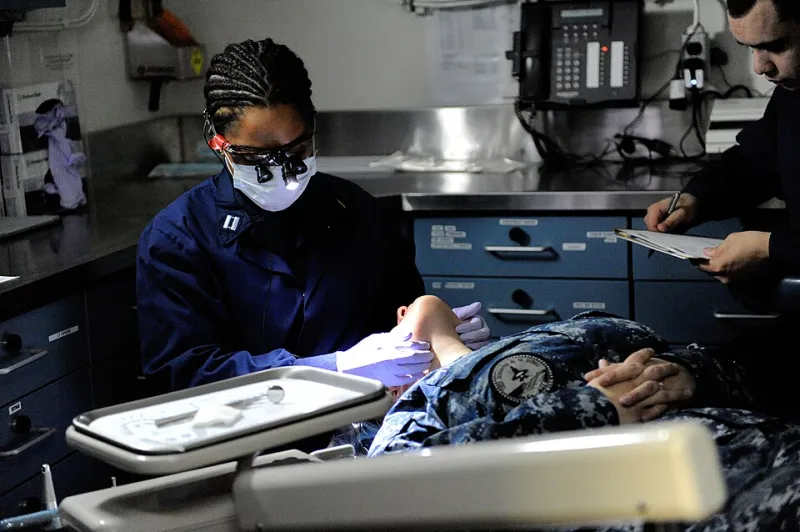
Photo: Official U.S. Navy Page, Public domain, via Wikimedia Commons
Most men expect their dentist to ask about flossing, cavities, and coffee stains. They do not expect a conversation about erectile function. That silence is understandable, but it can leave an important piece of whole-body health sitting in the waiting room. Gum disease is common, often painless in its early stages, and increasingly studied for its relationship to blood vessel health. Because an erection depends on healthy blood vessels, the mouth is a reasonable place to start asking better questions. A dental exam cannot diagnose erectile dysfunction, and gum treatment is not a substitute for prescribed tadalafil. But oral inflammation may be one more signal worth discussing with the clinician who manages your care.
The biology: inflammation, blood vessels, and nitric oxide
Periodontal disease begins with plaque, the sticky film of bacteria that forms on teeth. In its early stage, gingivitis, the gums can become red, swollen, and prone to bleeding. When gingivitis persists, it can progress to periodontitis, in which the gums pull away from the teeth and form pockets that harbor bacteria. The body's immune response to those pockets can become chronic. Researchers have found that inflammatory mediators and oral bacteria may enter the bloodstream, and chronic inflammation is known to affect the endothelium—the thin layer of cells lining blood vessels.
That matters for erection because an erection is a vascular event. Sexual arousal triggers the release of nitric oxide, which relaxes smooth muscle in the penile arteries and increases blood flow. A second messenger, cGMP, helps sustain that relaxation. Tadalafil works by slowing the breakdown of cGMP, but it still depends on the body's own nitric-oxide signaling and on blood vessels that can respond. If endothelial function is compromised by inflammation, smoking, diabetes, or other vascular risk factors, the response may be less robust.
The evidence here is best described as association, not proof of cause and effect. Gum disease and erectile dysfunction share several risk factors, including age, diabetes, smoking, and metabolic health. Treating gum disease may improve markers of inflammation, but it has not been shown to cure ED. The reasonable takeaway is not that every man with bleeding gums will develop erectile problems. It is that oral health belongs in the same conversation as circulatory health.
Why dentists rarely bring up sexual health
Dentists are trained to examine the mouth, not to counsel on sexual function. A routine dental visit is already crowded with X-rays, cleanings, insurance questions, and treatment planning. Many clinicians also worry about making patients uncomfortable. The evidence linking periodontal disease to erectile dysfunction is not yet strong enough to support routine dental screening for ED, and sexual health is not a standard part of most dental histories.
That is not a conspiracy. It is a gap. Many dentists do ask about medications and conditions such as diabetes and heart disease, because those affect oral health and treatment planning. But the conversation often stops before sexual function. Men, in turn, may not volunteer information about erections in a dental chair. The result is a missed opportunity rather than a failure.
What to say at your next dental visit
You do not need to turn a cleaning into a sexual-health consultation. A few direct statements can help your dental team see the bigger picture:
- Mention bleeding when you brush or floss, even if it is occasional.
- Report persistent bad breath, receding gums, loose teeth, or tenderness when chewing.
- Ask whether the dentist can perform or review periodontal probing and explain your pocket depths.
- Share relevant health history, including diabetes, heart disease, smoking, and medications.
- If you take tadalafil or another ED medication, you can include it in your medication list. That helps the dental team understand your vascular health and screen for drug interactions.
- Ask whether a referral to a periodontist is appropriate if you have deep pockets, bleeding, or bone loss.
What to bring to your ED provider
Just as dentists do not routinely ask about erections, many ED providers do not routinely ask about gums. Close the loop from the other direction. When you speak with a clinician about tadalafil, mention recent dental cleanings, any diagnosed gum disease, and symptoms such as bleeding or loose teeth. Bring a current medication list and be ready to discuss vascular risk factors such as blood pressure, cholesterol, glucose, and smoking.
A good clinical review should consider more than checkout. CialiSun's model is built around discreet access and medical review, but discretion should not mean fragmentation. The more complete the picture you provide, the more useful the guidance you can receive. If you are comparing online providers, look for one that asks about whole-body health rather than treating a prescription like a retail transaction.
A two-chair checklist
At the dental chair, focus on prevention: brush twice daily, floss or use an interdental cleaner, keep regular cleanings, and ask for periodontal measurements if you have symptoms. At the ED provider's chair, focus on context: share gum symptoms, vascular history, and medications. Neither chair replaces the other. Oral care is one lever in a whole-body approach, not a standalone cure.
The takeaway
Caring for your gums is not glamorous, and it will not replace a prescribed ED medication. But it is a low-risk, high-value habit that supports general health. The goal is not to blame your gums for every erection problem. It is to stop treating the mouth as separate from the circulatory system. If your gums bleed, say so. If your erections have changed, say that too—to the right clinician. Whole-body care works best when the mouth is part of the conversation.