Pick the wrong landscape lighting system, and you pay for it twice-once at installation, then again in dim paths, dead batteries, trenching costs, or fixtures that fail when you need them most. I’ve seen homeowners overspend on solar where low-voltage made more sense, and overbuild low-voltage setups for areas solar could handle cheaply.
After comparing real-world installs and homeowner maintenance headaches, one pattern is clear: the best choice depends on sun exposure, wiring access, budget, brightness needs, and how much upkeep you’ll tolerate. Ignore those factors, and the “cheaper” option often becomes the expensive one.
Below, I break down exactly how low-voltage and solar lighting compare on cost, performance, reliability, installation, and long-term value-so you can choose the right system for your yard the first time.
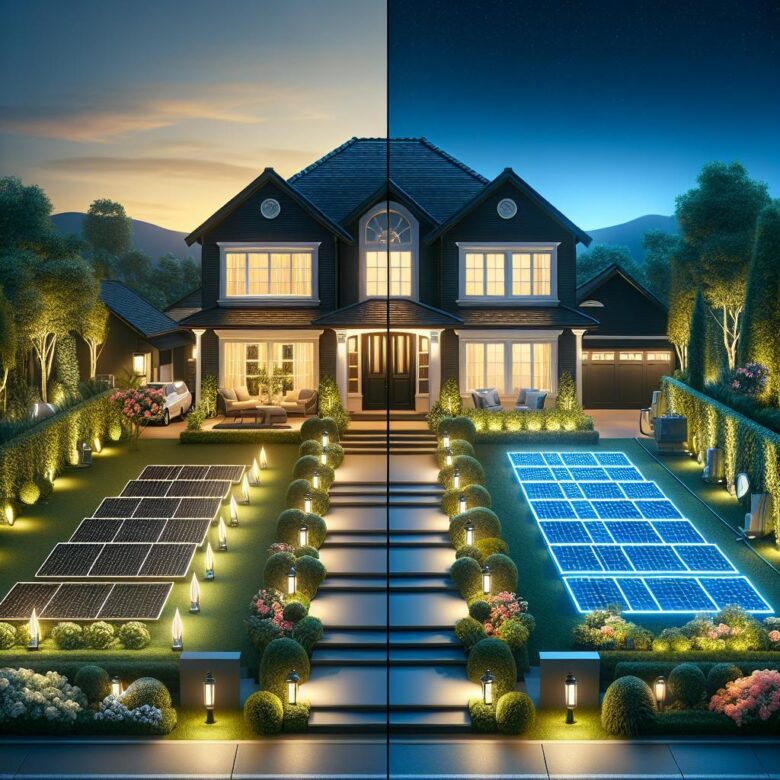
Low-Voltage vs. Solar Landscape Lighting: Upfront Costs, Long-Term Value, and Real-World Performance
Most homeowner comparisons miss the real cost driver: replacement cycles. A solar path light that looks inexpensive at checkout often needs battery swaps every 12-24 months and full fixture replacement far sooner than a properly sized 12V system with a quality transformer.
| Factor | Low-Voltage | Solar |
|---|---|---|
| Upfront Cost | Higher initial spend for cable, transformer, and labor; easier to model accurately with VOLT Lighting Hub or fixture load calculations. | Lower fixture cost and minimal installation labor, especially for small pathways or temporary layouts. |
| Long-Term Value | Better lumen stability, fixture longevity, and serviceability; LED engines commonly outlast rechargeable solar batteries by several years. | Lower maintenance only in ideal sun exposure; shaded lots, winter performance, and battery degradation quickly erode savings. |
| Real-World Performance | Consistent output, better beam control, and predictable runtime from dusk to dawn with proper voltage-drop management. | Output varies by panel orientation, cloud cover, and charge state; many units fade by late evening even if labeled “all-night.” |
Field Note: On a heavily treed property, I replaced 18 “high-output” solar stakes that were dead by 9 p.m. with a 150W low-voltage layout, and the client’s first reaction was not brightness alone-it was finally seeing the stone steps clearly at 11:30 p.m.
How to Choose Between Low-Voltage and Solar Lights for Paths, Patios, Driveways, and Security Zones
Most path-light failures are specification errors, not product defects: solar fixtures are routinely installed in shaded zones where winter charging drops below usable levels, while low-voltage systems are underbuilt for wire run and voltage drop. Choose by runtime reliability first, then by installation constraints, beam control, and maintenance access.
- Paths and patios: Use solar only where fixtures get 6+ hours of direct sun and decorative output is acceptable; use low-voltage for consistent lumen levels, tighter spacing, and dimming or zoning through transformers sized in VOLT Lighting Designer or equivalent voltage-drop calculators.
- Driveways: Low-voltage is the better technical fit because longer setbacks, wider beam spreads, and vehicle-oriented wayfinding demand stable output that solar units often cannot maintain through cloudy cycles.
- Security zones: Choose low-voltage whenever detection, camera support lighting, or all-night illumination matters; solar works only for supplemental perimeter markers, not for dependable vertical face lighting or layered coverage near entries and gates.
Field Note: I replaced twelve “bright” solar bollards along a north-facing drive after a December site audit showed only 90 minutes of usable output, and a recalculated 12V LED layout with heavier-gauge cable immediately corrected both darkness at the apron and uneven light at the gate columns.
Brightness, Battery Life, Wiring, and Maintenance: What Homeowners Need to Know Before Buying Outdoor Lighting
Most outdoor lighting disappoints for one simple reason: homeowners buy by fixture count instead of delivered lumens at the target surface. For paths, 50-150 lumens per fixture is usually enough, but steps, entries, and focal trees often need tighter beam control and higher output than solar units can sustain through multiple cloudy days.
- Brightness: Low-voltage systems provide consistent output because transformer-fed fixtures are not limited by a small onboard panel and battery; use Volt Lighting Hub or a photometric layout tool to avoid hot spots, glare, and underlit transitions.
- Battery Life: Solar performance depends on panel orientation, winter sun angle, battery chemistry, and nightly runtime settings; lithium-ion models outlast NiMH, but both degrade faster in heat and after repeated deep discharge cycles.
- Wiring and Maintenance: Low-voltage wiring requires voltage-drop planning, proper burial depth, weatherproof connections, and transformer sizing, while solar reduces trenching but demands regular panel cleaning, battery replacement, and fixture repositioning as landscaping matures.
Field Note: I recently corrected a dim backyard installation by replacing undersized 16-gauge cable with 12-gauge on a 180-foot run, and the homeowner immediately saw why “easy solar swap-outs” had never matched the uniformity of a properly loaded low-voltage system.
Q&A
1. Which is better for my yard: low-voltage lighting or solar lighting?
It depends on your priorities. Low-voltage lighting is usually the better choice if you want consistent brightness, longer runtimes, and a more polished look for pathways, landscaping, and outdoor living areas. Solar lighting works well if you want easy installation, no wiring, and lower upfront effort, especially for accent lighting in sunny locations.
| Factor | Low-Voltage Lighting | Solar Lighting |
|---|---|---|
| Brightness | More reliable and generally brighter | Often less bright and can vary by model |
| Installation | Requires transformer, cable, and planning | Simple, usually stake-and-place |
| Performance | Consistent even in cloudy weather | Depends heavily on daily sun exposure |
| Best Use | Pathways, steps, patios, security, feature lighting | Decorative accents, garden borders, temporary setups |
2. Is low-voltage lighting worth the higher upfront cost compared to solar?
For many homeowners, yes. Low-voltage systems typically cost more at the start because of the transformer, wiring, and possible professional installation. However, they often deliver better long-term value through stronger performance, replaceable components, and a more durable system. Solar lights may seem cheaper initially, but lower-end models often need earlier replacement due to battery failure, weaker output, or weather-related wear.
- Choose low-voltage if you want durability, higher light quality, and a permanent lighting plan.
- Choose solar if your budget is tight or you want a quick, low-commitment solution.
- Check maintenance costs because solar lights usually require battery replacement, while low-voltage systems may need occasional fixture or bulb servicing.
3. Why do solar lights often stop working well, and would low-voltage avoid those problems?
Solar lights commonly lose performance because of limited sunlight, aging rechargeable batteries, dirty solar panels, or poor placement under trees, eaves, or shade. In winter and cloudy seasons, their runtime and brightness often drop noticeably. Low-voltage lighting avoids most of these issues because it draws steady power from your home’s electrical system through a transformer, so it is far less affected by weather or seasonal daylight changes.
- Solar lighting problems: reduced charging, shorter runtime, dim output, battery degradation.
- Low-voltage advantages: dependable operation, better lumen output, easier use for safety and security lighting.
- Important tradeoff: low-voltage requires wiring and a more involved installation process.
Expert Verdict on Best Low-Voltage vs. Solar Lighting: A Homeowner’s Comparison Guide
Your best choice comes down to how you want the space to perform after dark-not just how it looks on day one. Low-voltage usually wins where consistency, brightness, and long-term control matter. Solar makes more sense where wiring is impractical or you want a faster, lower-commitment upgrade.
Pro Tip: The biggest mistake I still see homeowners make is buying fixtures before testing nighttime light levels. If you only do one thing next, walk your property tonight, take photos of the darkest areas, and mark each spot that needs safety, accent, or pathway lighting. That 10-minute audit will prevent overbuying, weak placement, and disappointing results.
Choose the system that fits your layout, climate, and maintenance tolerance-not just the product with the best box claims.

Dr. Alistair Vance is a sustainable design consultant and renewable energy expert with a Ph.D. in Environmental Architecture. With over a decade of experience in solar integration, he specializes in blending cutting-edge photovoltaic technology with modern home aesthetics. Dr. Vance is dedicated to helping homeowners transform their outdoor spaces into eco-friendly sanctuaries through smart, solar-powered lighting solutions.